When survival becomes the normal state.
Many people who come to me have not experienced war, an accident or a disaster. And yet they show patterns we know from trauma research: they are constantly tense or numb inside, they overthink, withdraw, overreact or just keep functioning. How does that fit together? That is what this article is about.
What trauma actually means
Many people know the term post-traumatic stress disorder (PTSD) from reports about war veterans. There it is easy to imagine that a person experiences something they cannot cope with. The experience stays stuck in the body. Feelings, thoughts and relationships get jammed, and every new situation can be overwhelming again.
Trauma is less the event itself than what it triggers in us. An experience becomes traumatic when it exceeds our capacities: when we can neither fight nor flee and our nervous system switches into an emergency state. Experts therefore distinguish between big, obvious trauma and many smaller, repeated strains. Both can leave similar traces.
The physician and author Gabor Maté sums it up: trauma is not what happens to you, but what happens inside you as a result of what happened to you. He distinguishes between big trauma, such as violence, abuse or war, and small, everyday trauma: experiences that seem harmless but leave deep traces, for example when a child repeatedly feels unseen.
The trauma therapist Janina Fisher has compiled typical effects of trauma. I encounter many of them every day in my practice:
- Hyperarousal: being easily startled, heightened, constant vigilance, panic attacks, irritability, insomnia
- Hypoarousal: inner numbness, emptiness, loss of interest, depression
- Dissociation: feeling beside yourself, memory gaps, poor concentration
- Re-experiencing: intrusive memories, nightmares, flashbacks
- Self-image: shame, self-devaluation, hopelessness
- Body and behaviour: chronic pain, headaches, eating disorders, addiction, self-harming behaviour
Trauma without war
We often tell ourselves: “Don’t make such a fuss. You had a good childhood.” Research paints a different picture. A large American study on adverse childhood experiences showed how common difficult childhood experiences are, such as emotional neglect, a parent’s addiction or mental illness, or separation, and how strongly they are linked to later psychological and physical illness.
When such strains occur early and repeatedly, experts speak of developmental trauma or attachment trauma. Since 2022 the international classification ICD-11 also includes complex PTSD. It describes the effects of long-lasting strain: difficulty regulating feelings, a deeply negative self-image and problems in relationships.
So someone who has been stuck for a long time, who is repeatedly angry, sad, empty, alienated or panicky, may just as well be shaped by trauma, even if they keep functioning on the outside. Inside there is often hopelessness, helplessness and the feeling of failing. Because we hide this inner failure from ourselves and others, it hardens over the years.
Functioning is not the same as living
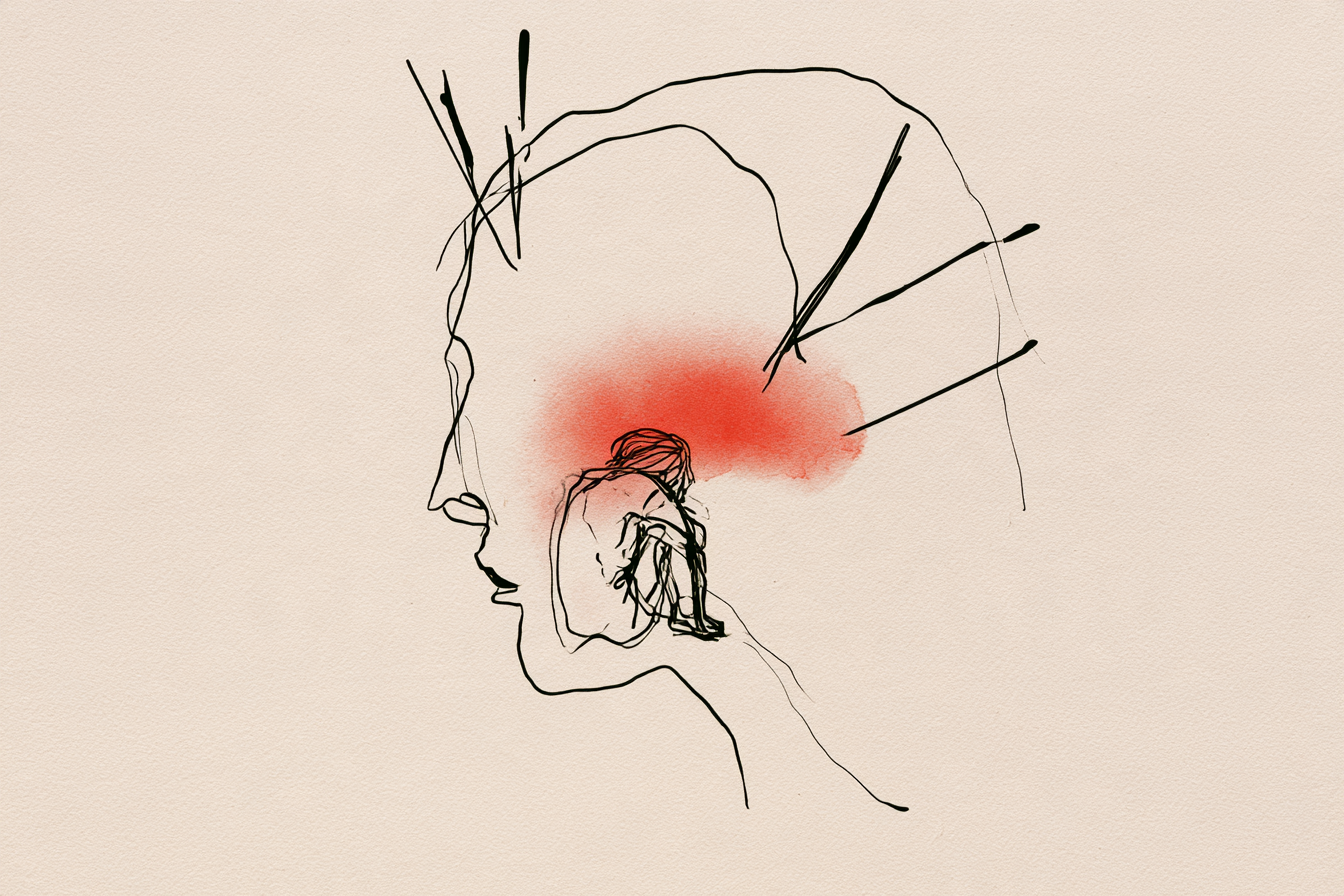
The psychiatrist and trauma researcher Bessel van der Kolk has shown that trauma is not just a memory but inscribes itself into brain and body. The title of his book says it in a nutshell: The Body Keeps the Score. Many people affected no longer feel safe in their own body. They lose contact with what is happening inside, with heartbeat, breath, tension and feeling. Experts call this perception from within interoception. Van der Kolk concludes: healing needs the body. Understanding alone is not enough.
A helpful image for this comes from the psychiatrist Dan Siegel, the window of tolerance: the range in which we can hold arousal and feelings without tipping into hyperarousal (fight, flight, panic) or hypoarousal (freezing, numbness). Trauma makes this window narrow. Even small triggers are enough, and we are outside it.
Many then learn to make themselves physically numb, mute or blind to what is happening around them. Wilhelm Reich called this armouring. It protects, but it costs aliveness. We remain stuck at the level of survival: we just about manage everything, but the feeling that life can be a gift, an adventure or a great challenge gets lost or is never discovered.
Where it begins: attachment and family
The roots often lie in the close family setting. Many people long for deep connection with parents, siblings, friends. Instead they experience distance and lack of interest early on, or the opposite: excessive worry, control, aggression, addiction or depression. Often because the parents are burdened themselves and cannot offer secure attachment.
Gabor Maté describes the conflict that arises: a child needs two things, attachment and authenticity, that is, the connection to its caregivers and contact with its own feelings. When the two don’t go together, the child chooses attachment. It learns to suppress anger, sadness or wishes in order to belong. As adults we then function, but we have lost contact with ourselves. In his book “When the Body Says No”, Maté describes how this loss can later show up physically too.
This constant, smouldering conflict between the longing for connection and its absence is a torment for many, one that can take over their whole sense of life.
How trauma is passed on
What one generation could not process continues to have an effect in the next. Research speaks of transgenerational transmission. Simplified, it often looks like this:
- Those affected experience war, flight, violence or severe loss.
- Their children grow up with emotional distance, silence or conflict in the family.
- The grandchildren feel a diffuse fear, guilt or a heaviness they cannot explain.
Parenting and attachment patterns are discussed here, but also biological traces, such as epigenetic changes. Research here is still young. What is clear: much of what we carry within us we never consciously chose.
What weighs on us: a list from practice
In my work I keep encountering these experiences as sources of everyday and transgenerational traumatisation:
- Emotional coldness, humiliation, being ignored
- Being underchallenged, mere politeness instead of real encounter, lack of physical contact
- Lies, boundary-violating behaviour, violence, dominance and powerlessness
- Accidents, bankruptcy, death, war
- Burdened family histories: flight, poverty, divorce, addiction
- Rigid ideas about sexuality, shaped for example by religion or a narrow environment
- One-sided moral judgements of anger, wildness, desire, strength and control that put part of our aliveness under suspicion
- Excessive safety thinking in family and culture: overprotection, compulsive cleanliness, parents who never let their child out of sight, the fear of traumatising one’s own child
The culture we live in
Our culture often lacks the knowledge of how to engage consciously with a good life. Society’s “Just get on with it!” almost never helps. It demands adaptation and performance, not perception. For many this creates a basic atmosphere in which being overwhelmed seems normal. Gabor Maté calls this the myth of normal: what counts as normal in our society, constant stress, isolation, permanent readiness to perform, is anything but healthy for body and psyche.
Fortunately, doors are opening in many places today to work with one’s own trauma. At the same time there are countermovements that want to turn exactly this back. People in fear are easier to steer. All the more important to regain your own perception.
The inner knot
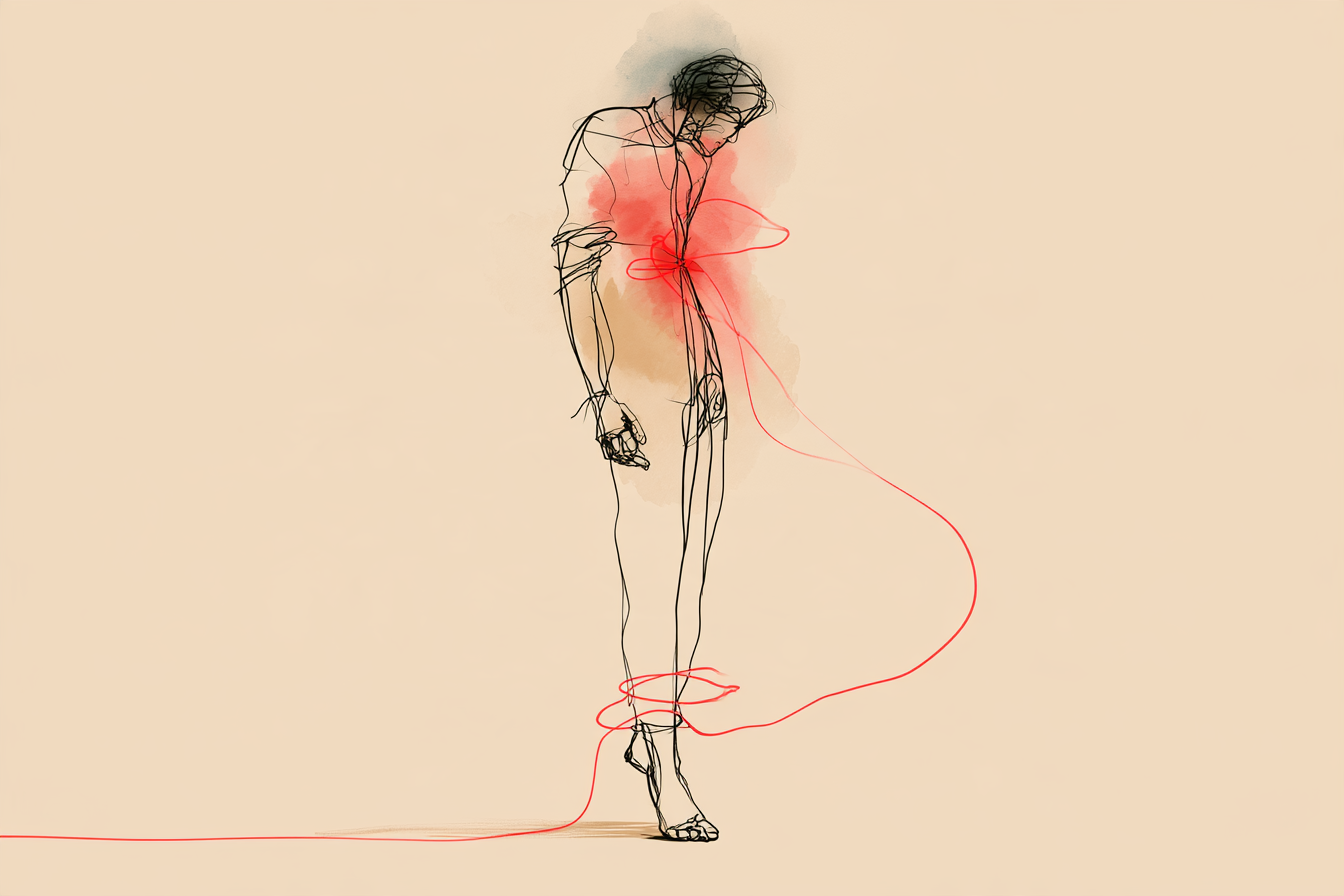
Much influences us without our noticing or ever having consciously decided on it. Just as unconsciously, individual experiences tie together into an inner knot. The more we pull at it, the more we talk at ourselves inwardly, the tighter it gets. That is how we end up in our very personal, seemingly unmanageable situation.
“You already understand a lot. And yet nothing changes?”
What bodywork can do
Because trauma is stored in the body, it can also be reached through the body. Bodywork is about building capacities: perceiving what is happening inside you, regulating tension and widening your window of tolerance step by step. We work with touch, movement, breath and conversation. Session by session, individual threads of the knot can loosen, and aliveness comes back through the crack in the armour.
With severe trauma-related conditions, bodywork does not replace trauma therapy. But it can complement it well. If you are unsure what suits you, we will clarify it in the introduction.
More in the article “Building capacities. In order to love.” and on the page Somatic psychotherapy, paying privately. Book a free introduction.
Sources and further reading
- Janina Fisher: Healing the Fragmented Selves of Trauma Survivors, Routledge 2017
- Vincent J. Felitti et al.: Relationship of Childhood Abuse and Household Dysfunction to Many of the Leading Causes of Death in Adults. The Adverse Childhood Experiences (ACE) Study. American Journal of Preventive Medicine 14(4), 1998
- World Health Organization: ICD-11, 6B41 Complex post-traumatic stress disorder
- Daniel J. Siegel: The Developing Mind, Guilford Press 1999 (concept of the window of tolerance)
- Bessel van der Kolk: The Body Keeps the Score, Viking 2014
- Gabor Maté: When the Body Says No. The Cost of Hidden Stress, Knopf Canada 2003
- Gabor Maté, Daniel Maté: The Myth of Normal, Avery 2022
- Peter A. Levine: In an Unspoken Voice, North Atlantic Books 2010
- Rachel Yehuda, Amy Lehrner: Intergenerational transmission of trauma effects: putative role of epigenetic mechanisms. World Psychiatry 17(3), 2018
- Wilhelm Reich: Character Analysis, 1933